
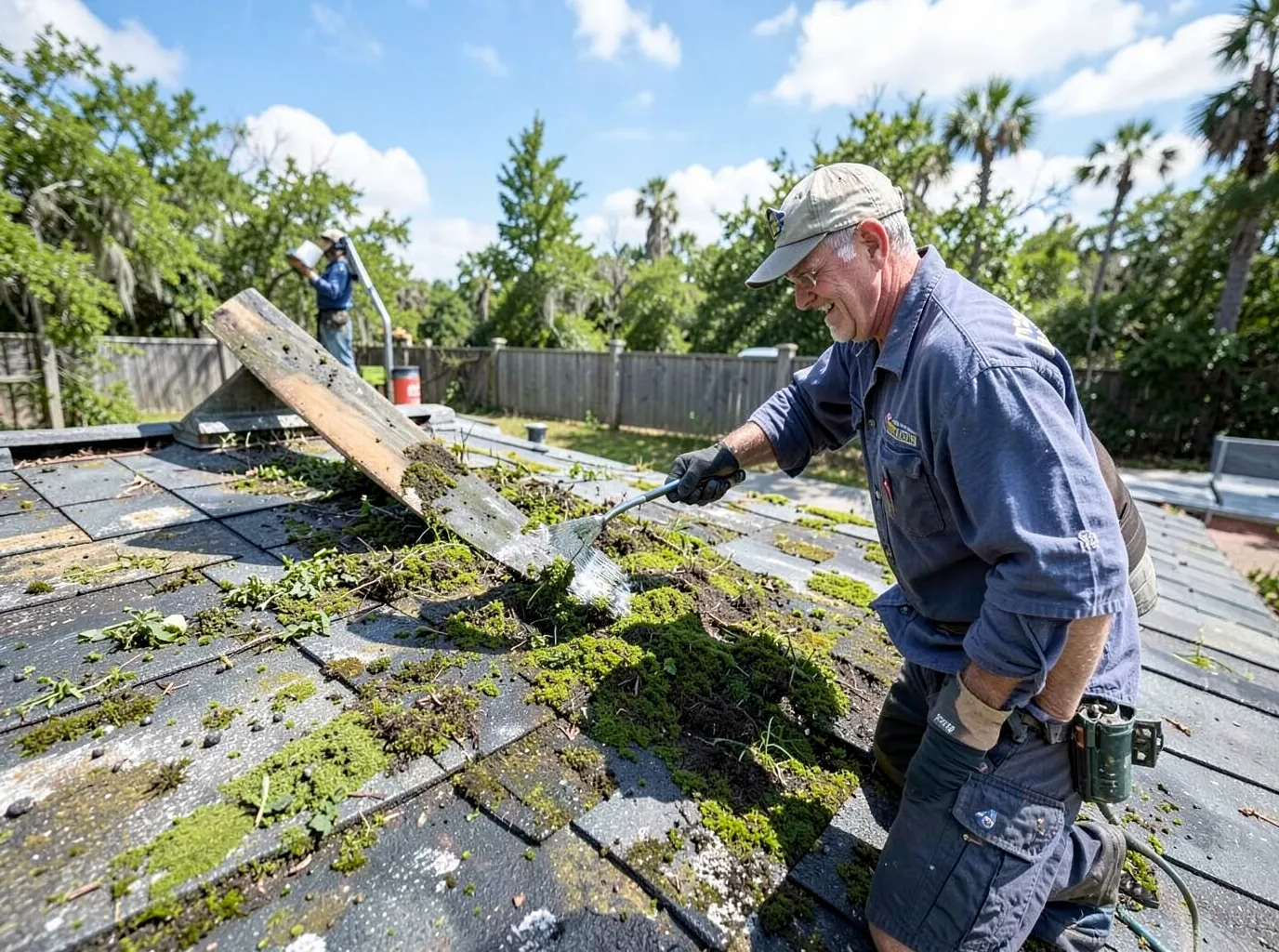
Port Orange’s humid subtropical climate drives fast moss and algae growth on north-facing slopes and shaded sections, especially around Cypress Head Golf Club and along the Halifax River where morning fog lingers. Homes in Allandale and Port Orange Hills built in the 1970s and 1980s often have asphalt shingles that hold moisture longer than newer synthetic materials, letting black algae streaks spread from valleys to eaves within a single rainy season. Soft washing with low-pressure application and algae-specific surfactants removes the growth without stripping granules, but crews must watch for older underlayment that can tear if water is forced under lifted tabs.
In neighborhoods like Twin Lakes and Riverwalk, mature live oaks drop debris into gutters and valleys, creating constant damp pockets that restart algae colonies within weeks. Treatment here includes clearing those valleys first, then applying a zinc-based inhibitor that matches the mild winter temperatures without leaving residue that could stain the Halifax River watershed. Tile roofs common near Spruce Creek Park require different dwell times so the cleaner does not etch the glaze, and crews test a small section before full application to avoid color shift on older barrels.
Volusia County building practices allow roof cleaning without a permit when no structural work occurs, yet runoff must be contained away from storm drains that feed the Halifax River. Homes backing up to Dunlawton or Sugar Mill often sit on slightly lower lots where standing water after summer storms keeps lower courses wet; these require extra attention to the starter course and drip edge. Skipping the rinse step or using off-the-shelf bleach mixes can leave salt deposits that accelerate granule loss once the next hot, humid summer arrives.
Technician insight
In Port Orange, the thing that catches most people out with Roof Moss & Algae Removal is how quickly algae returns on north slopes of 1970s–80s homes in Allandale once the live oaks leaf out; the shade plus Halifax River humidity keeps those surfaces damp long after the rest of the roof dries.
North-slope algae on a 1982 Allandale home
Heavy black streaks had spread from the valley across the north-facing shingles after two wet summers. Inspection showed debris-packed valleys and older felt underlayment that could not tolerate high pressure. We cleared the valleys, applied the surfactant at low pressure, rinsed carefully, and installed zinc strips along the ridge. The homeowner reported no new streaks the following spring.
Roof Moss & Algae Removal Services We Offer
✓Shingle Roof Moss Removal
Low-pressure soft wash and manual scraping to clear thick moss mats from asphalt shingles common in Allandale and Twin Lakes without dislodging granules.
✓Algae Stain Treatment
Application of EPA-registered surfactants to lift black streaks from shingles and tile on homes near Cypress Head and Spruce Creek Park while protecting surrounding landscaping.
✓Valley and Gutter Clearing
Removal of leaf debris and sediment from valleys and gutters on Riverwalk and Port Orange Hills properties to eliminate the damp pockets that restart algae growth.
✓Zinc Inhibitor Application
Installation of zinc strips or spray treatment along ridges to slow regrowth in the humid conditions found throughout Volusia County near the Halifax River.
✓Tile Roof Cleaning
Gentle cleaning of concrete and clay tile roofs in Spruce Creek and Sugar Mill to remove algae without etching the surface or forcing water under the tiles.
Roof Moss & Algae Removal Cost in Port Orange, FL
| Service | Typical Range | What Affects It |
|---|---|---|
| Single-story shingle roof moss removal | $350–$650 | Higher when mature trees shade the roof in Allandale or Twin Lakes |
| Two-story home with tile sections | $550–$950 | Extra time required for safe access and longer dwell times on tile |
| Valley and gutter clearing add-on | $125–$225 | Common in Riverwalk and Cypress Head where oaks drop heavy debris |
| Zinc inhibitor reapplication | $150–$300 | Recommended every 3–5 years in Volusia County’s humid climate |
Ranges are typical for Port Orange, FL and confirmed with an exact written quote before any work starts.
How it works
- 1
On-Site Assessment
Walk the roof and inspect from the ground and attic to map growth patterns, note shingle condition, and check for existing leaks around valleys in Port Orange neighborhoods.
- 2
Protection and Containment
Cover landscaping, HVAC units, and driveways, then set up containment so cleaning solution does not reach storm drains feeding the Halifax River.
- 3
Treatment Application
Apply algae-specific cleaner at the correct dwell time, agitate valleys and shaded sections, then rinse at controlled pressure to avoid forcing water under lifted shingles.
- 4
Final Inspection and Inhibitor
Check all slopes for missed streaks, install or refresh zinc strips, and document the roof condition for the homeowner before leaving the site.
Pricing
Cost depends on roof size, pitch, and how established the growth is; most single-story homes in Port Orange fall in the mid-range of local quotes.